Voyager 1 Becomes the First Spacecraft to Reach One Light-Day From Earth
Nearly half a century after launch, NASA's Voyager 1 crosses a distance so great that a radio signal now needs a full 24 hours to travel between the probe and Earth.
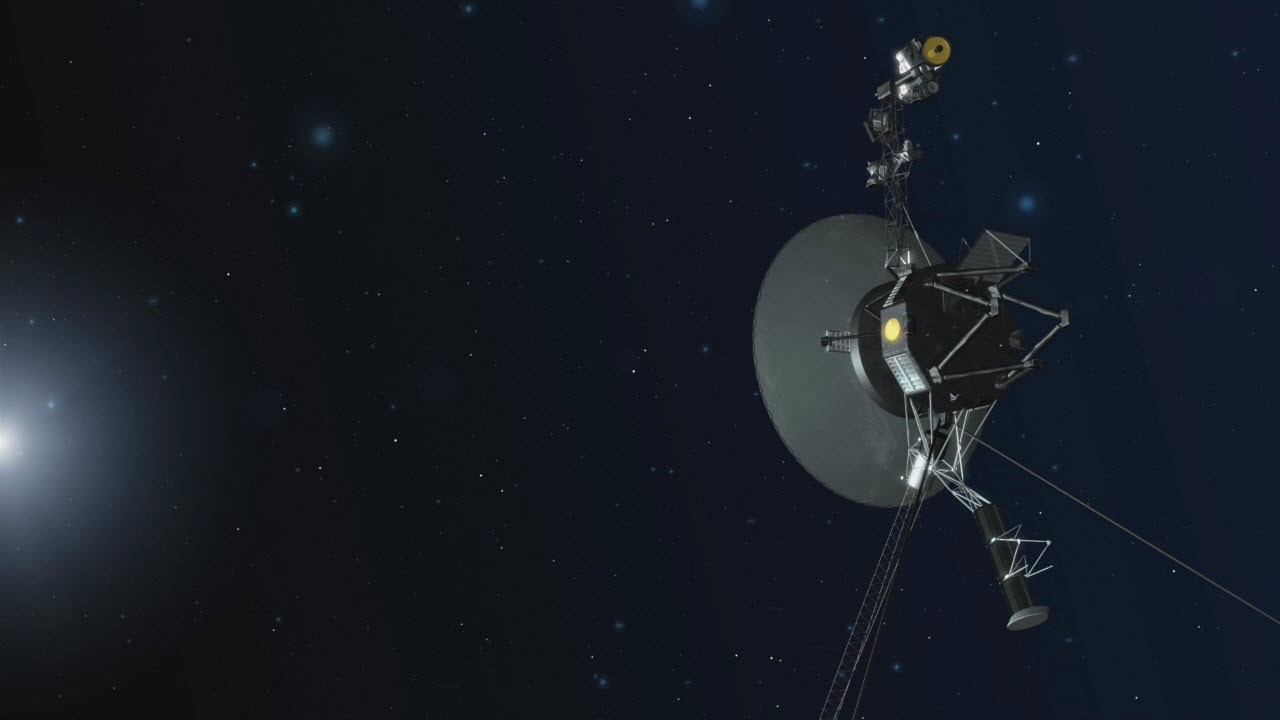
Image: NASA/JPL-Caltech. Pictured: artist's concept of a Voyager spacecraft in interstellar space.
NASA's Voyager 1 is today crossing a mile marker no other human-made object has reached: one light-day from Earth. According to NASA, the spacecraft passes the mark on Wednesday, 18 November 2026, at 5:16:07 a.m. EST (10:16:07 UTC, or 11:16 a.m. West Africa Time).
A light-day is a measure of distance, not time. It is how far light travels in 24 hours: 16,094,799,096 miles, or 25,902,068,356 kilometres, by NASA's figures. Getting there has taken Voyager 1 exactly 49 years, two months and 11 days since its launch on 5 September 1977.
A day-long phone call
The milestone has a very practical meaning for the engineers at NASA's Jet Propulsion Laboratory, a division of Caltech, who manage the mission. At this distance, a radio command sent from Earth takes a full day to reach the spacecraft, and any reply takes another day to come back. NASA said its Voyager team would not receive its return call from the moment of the crossing until the same time on 19 November.
Space.com noted that this delay shapes how controllers plan operations, troubleshoot problems and judge whether commands have worked. For comparison, NASA points out that light crosses the distance to the Moon in about 1.3 seconds, reaches Earth from the Sun in about eight minutes and 20 seconds, and takes between three and 22 minutes to travel between Earth and Mars. Neptune, the most distant planet, is about four light-hours and 10 light-minutes away.
Voyager 1 is moving at nearly 38,000 mph (61,000 km/h), according to NASA. That is very fast by human standards, but still a crawl next to light. The probe is heading in the general direction of a star called AC +79 3888, also known as Gliese 445, in the constellation Ursa Minor. NASA expects it to pass within about 1.7 light-years of that star in roughly 40,000 years.
Why the second launch got there first
Voyager 2 actually launched first, on 20 August 1977. Voyager 1 followed about two weeks later on a faster, shorter trajectory, and it overtook its twin on 15 December 1977. It reached Jupiter on 5 March 1979, four months before Voyager 2 arrived on 9 July.
The two paths then split. Voyager 1's close flyby of Saturn's large moon Titan bent its course northward, out of the plane in which most of the planets orbit the Sun. Voyager 2 was aimed onward to Uranus and Neptune, taking advantage of a planetary alignment that NASA says occurs about every 175 years. According to Space.com, Voyager 2 picked up speed at each planet except Neptune, where its turn to fly by the moon Triton cost it velocity.
The result, Space.com reports citing NASA, is that Voyager 1 now travels outward at about 3.5 astronomical units (Earth–Sun distances) per year, compared with about 3.1 for Voyager 2. NASA expects Voyager 2 to reach its own one-light-day mark in November 2035.
Still working after 49 years
Voyager 1 became the first spacecraft to enter interstellar space, the region beyond the Sun's bubble of particles and magnetic fields, in August 2012. Many of its science instruments have since been switched off to conserve energy, but NASA says the probe is still returning data from that largely unexplored region.
Its earlier discoveries changed how scientists understand the outer planets. The mission found active volcanoes on Jupiter's moon Io, showed that Jupiter's Great Red Spot is a huge, rotating high-pressure storm, and revealed that Saturn's rings are not uniform sheets. Voyager 1 also took the "Pale Blue Dot" image, which shows Earth as a single pixel in a beam of sunlight, photographed from beyond the orbit of Neptune.
To mark the occasion, NASA invited people around the world to "Shine Bright for Voyager's Light-Day" after sunset on 17 November, by flashing the letters V-G-R in Morse code toward the sky with phones, flashlights and even entire buildings.
For students and educators, the milestone offers a clear way to explain the scale of space. A light-year, the distance light covers in a year, is about 5.88 trillion miles (9.46 trillion kilometres), and even our nearest neighbouring star system, Proxima Centauri, is about 4.24 light-years away, according to NASA. Voyager 1 and its twin each carry a Golden Record of sounds and images from Earth, and NASA says both will drift through the Milky Way forever.
- NASA Science, "Voyager 1: What Is a Light-Day", November 2026
- NASA Scientific Visualization Studio, "NASA's Iconic Voyager Mission Reaches New Interstellar Milestone", 16–17 November 2026
- NASA Science, "Voyager 1: The Farthest Spacecraft"
- NASA Science, "Planetary Voyage"
- Space.com, "NASA's Voyager 1 launched second, so how did it beat Voyager 2 to a light-day by nearly a decade?", 17 November 2026
- Space.com, "What exactly is a light-day?", 16 November 2026
Want to work on stories like this?
Arakis Academy takes you from curiosity to career in space, with courses built for learners everywhere.
Start Learning